
Introduction

The 57 acres that comprise Cedar Ridge Farm are located in the beautiful rolling hills of South Central Kentucky. My wife, our four children, and I are on a homesteading adventure as we work toward increased self-sufficiency. We grow much of our own food and enjoy being in touch with the agrarian roots of our lives.

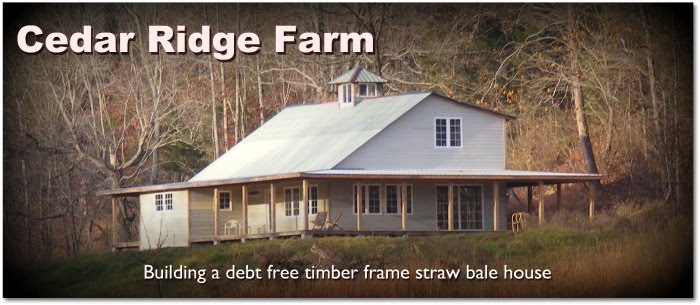
One of the major projects we have undertaken is the building of our own home. The house we're building has three major distinguishing features: 1. we're building it without incurring any debt; 2. it is a timber frame structure; and 3. the exterior walls will be plastered straw bales. We live debt and mortgage free, and building our house with that approach makes perfect sense. Large timbers in a home possess a beauty and project a sense of strength, stability, and warmth that we want in our home. Straw bale walls provide insulation and make ecological sense. This blog is a record of our home-building project.

Tuesday, April 30, 2013

If I don’t blog, did it really get done?

Well, the winter is over, although spring tried to drag it closer to summer. During the winter, I built a fire in the highly inefficient wood stove in the house occasionally. I would say once a week on average I would get a fire going, stuff the stove with as much wood as possible (mostly dried sycamore – not something that would burn for long, but it’s what I had), and close it down. After we stopped work on the house last fall, the indoor temperature was about 60-65 degrees. Adding only a little heat inside, the temperature bottomed out in the house at around 45 degrees. I’m looking forward to seeing what it will be like with a continuous fire when we’re living in it.

I did a few things but not much on the house over winter. Without keeping a lot more heat in there, plaster wasn’t going to dry well. And, without a more efficient stove, that was going to be problematic. Wintertime seems to have other things to commit my time to, anyway. Also, the day light period seems to be shorter for some reason.

I was able to accumulate a few things for the house (I’m still accumulating, actually). I bought interior doors. They are 3’ by 7’ solid core doors that were intended for a doctor’s office, but they had too many. I’ll have to cut them down 016to the right size and face the edges, but I think they’ll work well (they’re heavy, too). We also bought a kitchen sink. We wanted a stainless steel double sink with double drain-boards. To get what we wanted, we ended up buying a commercial sink.

In march I bought plumbing supplies for running the water lines. I decided to use PEX tubing which I had never worked with before. A friend lent me crimping tools, and I bought all the supplies locally. 015All the water supply lines are in. I still have to plumb the range boiler for the hot water (heated by the wood stove), but the lines are stubbed out for doing so. I’m actually going to plumb a similar tank on the summer kitchen with the wood stove we’ll use out there for hot water in the summer time. Because of the location for the two stoves, these will be two separate systems with valves to manually select which one to use.

After completing the water lines, I started on the drain lines in April. These are now completed, too. I still have to arrange for a septic system to be installed. We were going to just have a gray water system, but we decided to go ahead and do a full septic system. If gray water isn’t handled properly, it turns into black water. As long as we have water in the cisterns, we’ll be able to use flush toilets. If water gets low, we will use sawdust (composting) toilets.

In addition to the pressurized water system, we will also have pitcher pumps in the house. The plan is to have four: one in the kitchen, one in the mudroom, 019and one in each bathroom. I just ordered an Oasis Pump – the description of it online looks quite good for our purposes. If it meets expectations, we’ll get more.

On Friday of last week, I decided to mix up some plaster. We quit a few batches shy of having the 2nd coat done last fall. I put one batch on in the morning, and then the 3 younger children joined me in the afternoon. We put 3 more batches on the walls in the afternoon. Two more batches will finish the 2nd coat. That means, the first and second coats will amount to more than 19,000 pounds of plaster – and that’s only counting dry ingredients. 004By the time the finish coat is completed, we’ll have somewhere in the neighborhood of 12 tons of plaster on the interior walls! That should be a good thermal mass.

Yesterday and today, we mixed and applied 4 batches of finish coat. These batches are about 100 pounds of dry ingredients each, half what the batches for the other coats. These batches have gone on the walls in the master bedroom. The process involves applying the mix to the walls by hand. I then trowel it smooth. After it begins to dry, I buff it with a piece of yogurt container lid. This helps to smooth it out and close up the pores by pushing the sand into the plaster.

We’ll keep working on things. The objective is to get this house done so that we can move in. We’re getting closer.

022023

Sunday, September 9, 2012

Video: House Tour, September 7, 2012

A video tour of the house filmed on September 7, 2012, just after we finished the 2nd coat of plaster on the downstairs walls.


http://youtu.be/8zv4w0z3T6Q

Second coat of plaster downstairs is finished

We were able to get back to plastering this last week. We spent the previous week getting the cisterns hooked up. The week before that was occupied with making hay while the weather was good for doing so.

We finished all of the straw bale walls in the downstairs by Friday, September 7, 2012. It took 28 batches to do them all. That’s nearly 3 tons more plaster on the walls once it’s all dry. So far, we’re up to 9 tons of plaster on the interior walls. That total will increase by another 3 tons by the time we’re done, I expect. I think of that as great thermal mass to help moderate the interior temperature during the year – warm in winter, cool in summer.

We hope to complete the second coat upstairs within the next two weeks.

005008

Cistern hooked up

Last summer, we buried three 1,500 gallon septic tanks (new ones) in front of the house to serve as a cistern for rain water collected off of the roof of the house. I also contracted with a local company to install 6-inch seamless gutters on the house. However, it took them a year before they came and completed the job. Thankfully, I wasn’t in a hurry. I patiently waited for them to do the job, calling them occasionally to find out when it would happen (it was almost always, “the first of next week unless the weather is bad”). Yeah, I could have hired someone else to install gutters, but the quote 008I got from this company was $700 cheaper than the quote I got from another company, and it cost less than what it would cost for me to install gutters.

Anyway, they showed up in late June this summer and installed the gutters. It took me until the last part of August to finally plumb our water collection system from the downspouts to the cistern. It wasn’t difficult. 012Basically, I ran 4-inch Schedule 35 sewer pipe from each of the four downspouts to the cistern. I installed a roof washer on the east side and on the west side of the house.

The roof washers purpose is to divert away from the cistern the first 100 gallons of water that come off of the roof in a rain storm. 010This allows dirt, bird droppings, and other contaminants that may have accumulated on the roof to be washed off with the beginning rain and not end up in our household water.

I contemplated upon how to design the roof washer system for the house. The design I settled on uses a 55-gallon barrel for each one. As water flows from the two downspouts on either side of the house, it flows into the barrel on that respective side. I used 2-inch PVC to connect to the barrel with a home-made floating ball valve in the line. 015The initial rain off of the roof will not generally be more than the 2-inch pipe can handle. The water flows around a ball contained in the space inside two 4-inch to 2-inch reducers. When the barrel is full, the ball floats upward and closes off the entrance for the water into the barrel. This is to help insure that nothing in the barrel can be washed out and back into the line to the cistern.

For the floating ball valve to work, the barrel must be sealed. The water and little bit of air left in it when full keeps the ball from sinking, effectively closing the inlet to the roof washer. I laid the barrels on their side so that water flows in through the top bung into which a regular 2-inch threaded PVC connector threads (2-inch NPT). The other bung which has different threads (very course) can be opened to drain the water out of the roof washer barrel after a rain shower. 018This system collects about 50 gallons on each side of the house before the water proceeds to the cistern.

We’ve had nearly 3 inches of rain during the last two weekends. I previously calculated that it would take about 2.5 inches of rain to fill the cisterns. My calculation was very close. The cistern was full and overflowing somewhere around 2.6 inches of rain. The overflow runs from the cisterns to the pond through a 100-foot section of 4-inch corrugated drain pipe.

The last thing I did to ready the system for water collection was to install 1/2-inch hardware cloth over the gutters. I bought 3-foot by 10-foot rolls of galvanized hardware cloth and cut it into 8-inch widths with a metal cutting blade. I inserted one edge two inches under the roof metal and attached it to the top of the outside edge of the gutters with self-drilling machine screws ever couple of feet. This keeps most of the leaves out of the gutters and out of the cistern. A few leaves that get through will end up in the roof washers. The rest of them are screened out before the water enters the cistern (it’s run through window screen). Before we use the water in the house, it will run through an inline screen filter, and all drinking water will be filtered with a ceramic filter or a reverse osmosis filtration system.

Wednesday, August 15, 2012

Twelve batches into the second coat

The second coat (also called the brown or infill coat) of plaster takes a lot of mud. Of course, we already knew that based upon our plastering experiences two years ago when we finished the exterior of the house.

The recipe that I’ve been using for the second coat is different than the recipe for the first coat (also called scratch or discovery coat). The first coat has a fairly high clay content. I used 1.5 parts clay-rich dirt to 2 parts sand. It can be done with equal parts clay and sand (there are variations depending on the clay content of the dirt being used). The more clay there is in the mix, the more cracking that occurs when the plaster dries. This is because clay expands when wet and shrinks when it dries. So, as the plaster dries, it naturally shrinks, and the shrinkage causes cracks (something has to give somewhere). For the first coat, that’s not a big deal – the cracks will be filled by the next coat and will actually help the second key into the first.

For the second coat I started with a mix using 1 part clay to 2 parts sand, but I’ve adjusted that on the last four batches to 1 part clay to 2.5 parts sand. Although cracks on this coat of plaster aren’t a real problem because they will be covered by the finish coat, I would like to minimize them as much as is realistic.

I’ve noticed that cracks are more apt to appear in areas where the plaster is thicker on the wall, presumably because the thinner areas surrounding the thicker dry faster, shrinking as they do. The thicker areas take longer to dry and are still wet enough to be weaker and therefore the first place to give. Less clay in the mix will allow less shrinkage and fewer cracks. The important part is that the plaster be strong enough, a characteristic dependent to a large extent upon the clay which is the substance that binds the plaster together, that makes it work (sand and water doesn’t make a good plaster).

We’ve mixed 12 batches of plaster for the second coat so far. We started in the kitchen, because I want the walls there to dry so we can put up the green board. They are mostly dry now, with only a few areas still damp. The weather played a role in that – it was humid and overcast with rain for several days. That’s not good drying weather. But, drier weather has returned, allowing the process to continue as needed.

The kitchen windows were the first ones I did with the second coat. They went well. The greatest challenge is above the windows. Somehow, gravity seems to work against me, causing plaster to fall. Sometimes it’s because it sticks to my hands more strongly than it sticks to the first coat, I think. But, once it’s pressed in firmly and troweled, it does fine. 004It’s just initially that a fair bit falls to the window sill. I pick it up and use it anyway (it’s not like it’s going to get dirty).

After the plaster is troweled and shaped, the windows look good. The important thing is to get the shape on the walls with this coat. Around the windows that means the curves I want. On the rest of the walls, the kitchen walls excepted, the idea is to even them out and give them the shape and smoothness desired in the final product. 002There will be a few areas that will need a third coat, though – some of the low spots require 4 inches or so of plaster, and that is too much at one time in some areas.

After the kitchen, we moved along the wall into the dining room. This wall has the most area to be plastered of all the wall sections. It’s 14 feet long, 9 feet tall, and has only one window. We finished it yesterday and then moved on to the living room walls. As you can imagine looking at the photo (to the right – click to e008nlarge any of the photos), the areas above the braces on the timber frame present some challenges because of the limited space to work in.

The wall near the chimney behind where the wood stove will be located presented the challenge of plastering behind the chimney. It wasn’t too bad, and, thankfully, it will not be seen anyway. 017This section of wall will require a third coat in places because of the depth of some low spots.

We moved on from the chimney, around the front door and to the double windows in the living room. We didn’t finish the living room walls today, but we’ve got a good start. It should only take one more batch to finish the second wall. The front wall is done.

We mixed and applied three batches of finish coat on the interior packed walls in the master bedroom earlier in the week. Interestingly, the finish plaster that we put on the upstairs walls a 011few weeks ago did not dry white as expected. It is white in places, but not as uniformly as I anticipated, like it did when I did a test patch last year after buying the kaolin clay. The only difference I know of in the mix is the addition of wheat paste. I bought some dried wheat past to help bind the plaster together, and I think it is keeping some of the clay from working to the surface when I hard trowel and buff the plaster. That’s okay because we’re going to paint all the walls with a clay paint anyway. The wheat paste does a good job binding 015the plaster, though, and it keeps the clay from dusting off if you rub on it. It makes a nice finished surface.

It looks like the walls in the bedroom may dry mottled in color, too. There are a few cracks that have developed as the plaster is drying. I’m going to adjust the amount of clay in the recipe. My books recommended more clay in the final coat than I expected, and I went with their recommendation. I think less clay will still work fine and will allow fewer cracks. I need to get some silica sand so that I can mix up some plaster with it to repair the cracks. Masonry sand, even when screened through a window screen, has too many large pieces to make a good patch plaster. I’m going to want some fine silica sand for the clay paint anyway.

In the next few weeks, I’m going to experiment with the clay paint, mixing up different batches to find a recipe that I like. It should be fun trying it out with additives like mica powder and/or mica flakes. I also have some natural yellow ochre pigment to see if I can come up with a nice pale yellow.

Friday, July 27, 2012

A little finish coat and some photos

On Wednesday this week, we decided to put the finish coat of plaster on the walls above the open, center section of the house. I wanted to get the scaffolding out, and we needed it for doing these walls.

I purchased some wheat paste from Natural Craft Supply the previous week which arrived this week. I can make my own wheat paste for less money using high-gluten white flour, but the product I bought is easy to use and works well. The idea with the wheat paste is that it works as a binder in the plaster. Basically, it’s a glue made out of flour (traditionally, it’s been used to glue wall paper to the wall). It helps to hold the plaster together more strongly and keeps the surface from dusting off when it’s dry. It works, too.

Our recipe for the finish plaster was to screen 5 gallons of sand through a window screen (it is amazing how many rocks can be screened out of sand). Then, we mixed in 3.25 gallons of dry, powdered, white kaolin clay by hand. 013Once that was mixed, we mixed in 1.5 pounds of wheat paste (about 3 cups of dry powder). The next step was to add water and mix thoroughly. It’s amazing how much water it can absorb – about 4 gallons.

We found that it is easiest to smear the plaster on with your hands after dampening the wall (we use a garden sprayer) and then trowel it as smooth as possible, adding or removing material as necessary. After the plaster has begun to set up a little as it begins to dry, I came back over it with a pool trowel to take out trowel marks from the previous step. I tried buffing it with a yogurt container lid, but I liked the trowel better.

020022

The plaster looks gray when it’s wet, but it dries to a white color. Later, I will mix up an alis to paint the walls with. An alis is a clay-based paint (clay, fine silica sand, wheat paste, and water). This will help even out the color (white because we’re using white clay – I’m not intending to put in any pigments) and seal up the finish coat a little more.

Yesterday, the boys and I straightened things up in the house and swept the floors. We also removed the scaffolding from the center of the house. I took a few photos to share.

031040


The photo below is one from three that my camera stitched together – the beams are not really curved like that.

038

July 24: First coat of interior plaster DONE!

We finished the first coat of plaster on the interior walls on Tuesday of this week. We’ve been working on this goal for the last month. It took 59 batches of plaster to get the first coat done – about 6 tons of dry material.

We finished the upstairs rooms on Monday, leaving the pantry and a couple of miscellaneous spots to be plastered on Tuesday. It was nice to finish this step.

Next, we’ll be put the second coat on the straw bale walls. This should go easier because it won’t be necessary to work the plaster into the bales.